EN
EN



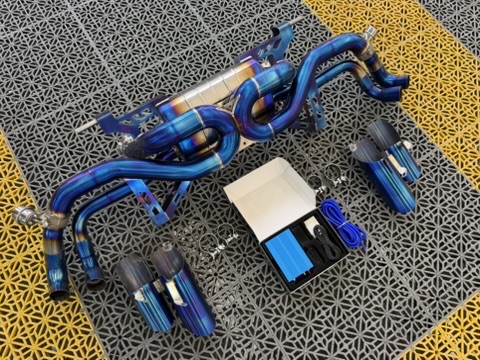
How Electric and Vacuum Exhaust Valves Work
A vehicle’s exhaust valve is a key component for managing sound, backpressure, and emissions, and its actuation method—electric or vacuum—determines responsiveness, integration complexity, and the engine conditions under which it works reliably.
Electric Exhaust Valve: Electronic Control, Motor Actuation, and Real-Time Position Feedback
An electric exhaust valve uses the engine management system—or a dedicated control unit—to send a pulse-width modulated (PWM) signal or CAN bus command to a small DC or stepper motor. The motor drives a reduction gearset that rotates a butterfly plate or gate inside the exhaust path. A potentiometer or Hall-effect sensor on the valve shaft provides continuous position feedback to the ECU, enabling closed-loop control. This allows precise, intermediate positioning—not just fully open or closed—so exhaust note and backpressure can be tuned dynamically across driving conditions. Because actuation is independent of engine vacuum, response remains consistent at idle, wide-open throttle, and under boost. Typical systems achieve full stroke in under 200 milliseconds, with positioning accuracy often within ±1% of full travel. Torque-limiting algorithms protect the motor from stalling, and many include a limp-home mode that defaults to a safe position during power loss. This combination of electronic control, motor actuation, and real-time feedback makes electric exhaust valves ideal for active sound management in performance vehicles and those equipped with advanced driver-assistance systems (ADAS) that require predictable, repeatable exhaust behavior.
Vacuum Exhaust Valve: Manifold-Dependent Diaphragm Actuation and Mechanical Simplicity
A vacuum exhaust valve operates by harnessing intake manifold vacuum. An ECU-controlled solenoid regulates vacuum flow to a diaphragm actuator, which moves a rod connected to the valve gate against a return spring. When manifold vacuum is strong—such as during light load or deceleration—the diaphragm pulls the valve open; when vacuum drops—as at wide-open throttle or under turbo boost—the spring closes it. The design is mechanically simple: no motor, gearbox, or position sensor is needed. Instead, it relies on vacuum lines, a check valve, and sometimes a small reservoir to stabilize pressure during transients. While this simplicity supports low cost and robustness in harsh environments, it introduces functional limits. Response is inherently slower due to vacuum line delay and diaphragm inertia—typically 100–200 ms—and actuation becomes unreliable when manifold vacuum collapses. Turbocharged engines and high-load conditions often leave the valve partially or fully closed when maximum flow is needed, leading to inconsistent sound and elevated backpressure. With no position feedback, the ECU cannot detect or correct drift, and aging components—diaphragms, hoses, and solenoids—are prone to leaks and degradation over time. Still, vacuum valves remain common in OEM applications where only two discrete states are required—e.g., “quiet” and “sport”—and where mechanical reliability and serviceability outweigh the need for precision.
Performance Comparison: Response, Accuracy, and Operating Conditions
Electric Exhaust Valve Advantages: Faster Response, Precise Positioning, and Full Throttle Compatibility
Electric exhaust valves eliminate dependence on engine vacuum, delivering fast, repeatable actuation regardless of load. Their direct electromechanical link enables sub-50 ms response times—significantly quicker than vacuum systems—and sub-degree positioning accuracy via integrated sensors. This precision supports dynamic strategies: the valve can open progressively during wide-open throttle to reduce backpressure, then close partially for noise compliance. Crucially, performance does not degrade under boost or at high RPM, where manifold vacuum may drop to zero or invert. Electric actuators also withstand high exhaust temperatures better than rubber diaphragms, avoiding thermal degradation. These traits make them especially well-suited for turbocharged, hybrid, and ADAS-equipped platforms where exhaust behavior must align tightly with real-time ECU decisions.
Vacuum Exhaust Valve Limitations: Lag, Inconsistent Actuation Under Low-Vacuum Scenarios (e.g., Turbo Engines, WOT)
Vacuum exhaust valves rely entirely on manifold vacuum to overcome spring force and move the diaphragm. That dependency creates inherent lag—due to hose volume, diaphragm compliance, and spring resistance—and inconsistent behavior when vacuum fluctuates. At wide-open throttle, vacuum collapses near zero, often leaving the valve stuck closed. In turbocharged engines, positive manifold pressure under boost renders the diaphragm inoperative. Even in naturally aspirated engines, transient throttle events cause fluttering or partial opening. Without position feedback, the ECU cannot compensate for drift or leakage. Over time, vacuum lines crack, diaphragms fatigue, and solenoids fail—leading to progressive, unpredictable degradation. While mechanically robust in stable conditions, this architecture struggles to meet the timing, accuracy, and repeatability demands of modern high-output and digitally integrated powertrains.
Reliability, Cost, and Vehicle-Specific Suitability
Total Cost of Ownership: Upfront Expense, Maintenance Frequency, and Failure Modes (Motor/Sensor vs. Vacuum Line/Diaphragm)
Electric exhaust valves carry a 30–50% higher initial cost than vacuum systems, reflecting their integrated motor, position sensor, and control electronics. However, vacuum systems incur recurring maintenance expenses: fleet data from 2023 shows diaphragm replacement is typically needed every 50,000–70,000 miles, while electric actuators commonly exceed 100,000 miles without intervention. Failure modes differ—vacuum valves degrade gradually (leaks, flutter, delayed response), whereas electric units may fail suddenly (motor stall, sensor fault)—but overall, electric valves demonstrate lower long-term cost of ownership. A 2023 aftermarket analysis estimates the total cost—including parts and labor—over 150,000 miles at approximately $620 for an electric system versus $840 for vacuum. This makes electric valves more economical for high-mileage commercial vehicles and performance applications, while vacuum systems retain value where low upfront cost, predictable servicing, and mechanical resilience are priorities—such as in heavy-duty diesel trucks and industrial equipment.
OEM Adoption and Aftermarket Integration of Exhaust Valves
OEM Trends: Why High-Reliability Applications Still Favor Vacuum, While EVs and ADAS-Equipped Vehicles Shift to Electric Exhaust Valves
Vacuum-actuated exhaust valves remain standard in heavy-duty diesel trucks, off-road machinery, and other high-reliability platforms where simplicity, heat tolerance, and ease of field service outweigh the need for precision. With no wiring, control modules, or sensitive electronics, they operate reliably in extreme vibration, dust, and temperature environments. In contrast, OEM adoption of electric exhaust valves is accelerating in vehicles requiring digital integration and adaptive behavior—especially those with ADAS, cylinder deactivation, or turbocharged/hybrid powertrains. These systems demand real-time, software-defined exhaust control that vacuum cannot deliver. Even battery electric vehicles (BEVs) without conventional exhausts reinforce this trend: extended-range EVs and fuel cell vehicles use electric exhaust valves for thermal management, purge venting, and safety-critical pressure relief—applications that benefit from programmable, fail-safe actuation. The result is a strategic OEM bifurcation: vacuum for rugged, uptime-critical platforms; electric for software-defined, performance- and safety-sensitive architectures.
FAQ: Questions About Electric and Vacuum Exhaust Valves
What are the main differences between electric and vacuum exhaust valves?
Electric exhaust valves use electronic controls and motors for precise positioning and fast response, while vacuum valves rely on intake manifold vacuum and mechanical actuation, offering simplicity but slower and less consistent operation.
Which type of exhaust valve is better for turbocharged engines?
Electric exhaust valves are better suited for turbocharged engines because they function reliably under boost conditions, whereas vacuum exhaust valves struggle due to reduced manifold vacuum.
How does cost affect the choice between electric and vacuum exhaust valves?
Electric exhaust valves have a higher upfront cost but lower long-term maintenance expenses. Vacuum exhaust valves are more cost-effective initially but may require more frequent maintenance over time.
Why do heavy-duty vehicles still use vacuum exhaust valves?
Vacuum valves are preferred for heavy-duty vehicles due to their simplicity, mechanical robustness, and ease of servicing in rugged environments.
Can electric exhaust valves integrate with ADAS systems?
Yes, electric exhaust valves are ideal for ADAS-equipped vehicles due to their precise, programmable control, which aligns with real-time ECU decisions.
Table of Contents
- How Electric and Vacuum Exhaust Valves Work
- Performance Comparison: Response, Accuracy, and Operating Conditions
- Reliability, Cost, and Vehicle-Specific Suitability
- OEM Adoption and Aftermarket Integration of Exhaust Valves
-
FAQ: Questions About Electric and Vacuum Exhaust Valves
- What are the main differences between electric and vacuum exhaust valves?
- Which type of exhaust valve is better for turbocharged engines?
- How does cost affect the choice between electric and vacuum exhaust valves?
- Why do heavy-duty vehicles still use vacuum exhaust valves?
- Can electric exhaust valves integrate with ADAS systems?